What is Dark Matter and why can't we see It?

Dark matter is one of the most critical enigmas of modern science, because even though we know that it exists and extends to every corner of the universe, we have no idea what it could be.
May 7, 2025
What is Dark Matter and Why Can't We See It?
Dark matter is one of the most critical enigmas of modern science, because even though we know that it exists and extends to every corner of the universe, we have no idea what it could be.
But, how can we know that something exists and, at the same time, not know what it is? Although it sounds a bit contradictory, this is somewhat more common than you think in science.
To make it completely clear to you, we must first explain how dark matter was discovered.
Origin and evidence for the existence of dark matter
Dark matter is one of the greatest mysteries of modern cosmology. Although we cannot see it directly, its presence forcefully manifests through its gravitational effects on visible matter in the universe.
But how do we come to the conclusion that this invisible matter exists?
The story begins at the beginning of the twentieth century, when astronomers began to notice discrepancies between the visible mass of specific astronomical systems and their dynamic behavior.
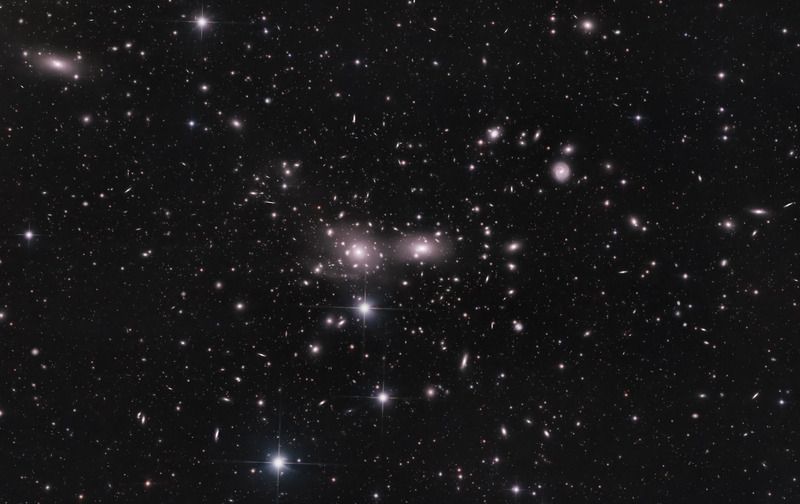
One of the first clues came from Swiss astronomer Fritz Zwicky, who in the 1930s studied the Coma cluster, a massive grouping of galaxies. By calculating the cluster's total mass based on the speed with which the galaxies were moving, he found that the amount of visible mass (coming from stars and interstellar gas) was not enough to hold the cluster together.
This meant that something invisible but with mass must be generating an additional gravitational force that held the entire cluster together, even though our telescopes couldn't see it.
For several decades, this hypothesis was met with skepticism. However, discoveries in the second half of the 20th century began to confirm that the problem was not unique to galaxy clusters.
Astronomer Vera Rubin studied the rotation curves of spiral galaxies in the 1970s. In theory, if all a galaxy's mass were concentrated in its visible stars, the rotation speed of the stars should decrease as we move away from the galactic center.
The hypothesis was that, just as planets orbit at a slower speed the farther away they are from the sun, stars in a galaxy should also move more slowly as they move away from the galaxy's center.
Surprisingly, Rubin observed that stars in the outlying regions rotated as fast as those in the center, which could only be explained if there was a large amount of non-visible mass surrounding the galaxies like a spherical halo.
That is, if the stars on the periphery of a galaxy move at the same speed as those near the center, it is because those on the periphery must be accompanied by an enormous amount of matter that we cannot see.
Since then, multiple lines of evidence have reinforced the idea that a significant fraction of the universe comprises this invisible matter.
Observations of the cosmic microwave background, the effect of gravitational lensing (the deflection of light by gravity), simulations of large-scale structure formation, and studies of dwarf galaxies all point in the same direction: there is a type of matter that is present in every corner of the universe, which we cannot see or measure in any way but can detect its gravitational influence on other bodies, that invisible and undetectable matter is what we call "Dark Matter".
As our valued readers may notice, dark matter was not an idea invented by a scientist's incredible imagination; rather, it is a necessary conclusion given astronomical observations that could not be explained with visible matter alone.
It is a fundamental piece of the cosmic puzzle, and its study has radically changed our understanding of the universe.
Why can't we see dark matter?
One of the most puzzling aspects of dark matter is that, despite occupying much of the universe's content, we can't see it. It does not emit, absorb, or reflect light or electromagnetic radiation.
This makes it entirely invisible to optical, infrared, and X-ray telescopes or any other instrument that relies on the detection of light or electromagnetic energy. But why does this happen?
To understand the magnitude of the enigma that dark matter represents, it is essential to differentiate it from what we call normal or baryonic matter. The latter is the matter we know, study, and experience daily: everything we see around us - people, animals, plants, planets, stars, interstellar gas, cosmic dust - is made of baryonic matter. It is a matter of atoms, whose nuclei contain protons and neutrons (baryons), surrounded by electrons.
Baryonic matter interacts in many ways. It responds to gravity, electromagnetic, strong nuclear, and weak nuclear force. That force can emit light, absorb it, form complex structures, merge into stars, and generate chemical reactions.
These interactions allow us to study ordinary matter with telescopes, microscopes, particle accelerators, and other tools. Modern astronomy is based almost entirely on observing light (visible, infrared, ultraviolet, X-ray, etc.) emitted by this matter.
Dark matter, on the other hand, does not emit or absorb light and does not participate in electromagnetic interaction. This means it does not heat up, cool down, glow, or be detected by electromagnetic waves. It only responds to gravity.
This is why dark matter does not form atoms, molecules, stars, or planets. It is much more diffusely distributed, forming large, invisible structures that envelop galaxies and galaxy clusters.
Dark matter is thought to have been instrumental in the early moments of the universe, attracting baryonic matter and enabling the formation of galaxies as we know them.
Another key difference lies in the composition. Baryonic matter comprises known particles: protons, neutrons, and electrons. On the other hand, dark matter particles are hypothetical; we have no idea what kind of particles make them up.
Many candidates have been proposed, such as WIMPs (Weakly Interacting Massive Particles), which would be heavy but extremely non-interactive, or axions, ultralight particles that could behave like a quantum field throughout the universe.
None have been confirmed so far, indicating that dark matter is composed of a fundamentally different type of matter than the one that makes up everything we know.
In other words, while baryonic matter is the "stuff" of which the visible universe is made, dark matter is an invisible component without an electrically charged component that does not form complex structures or is detected by traditional means, but whose gravity dominates the behavior of most of the cosmos.
Another reason we can't see it is our reliance on radiation for information from the cosmos. From the earliest telescopes to the most modern space probes, our window on the universe has been based on light and other forms of electromagnetic radiation.
But if a component of the universe does not use this language, we cannot "see" it directly. We can only infer its existence through its gravitational effects, such as when we detect the presence of a planet by observing how it affects the orbit of another nearby planet.
In this context, dark matter behaves like a cosmic ghost: we can't see it, touch it, or catch it, but we know it's there because otherwise the universe wouldn't behave the way it does.
Its existence challenges our current ideas about particle physics and shows that the Standard Model, although wildly successful, is not enough to describe everything that exists.
Thus, dark matter represents not only an observational challenge but also a theoretical frontier. It forces us to think beyond the visible, develop new technologies, and consider the possibility of a physics yet to be discovered.
How do we know how much dark matter is in the universe?
Although we can't see dark matter directly, astronomers have accurately estimated the amount of it in the universe.
The key is to observe how large-scale cosmic structures behave and how the universe evolves from its beginnings. To do this, various observational tools, theoretical models, numerical simulations, and the work of hundreds of scientists working in the most advanced laboratories in the world have been used. Some of them are:
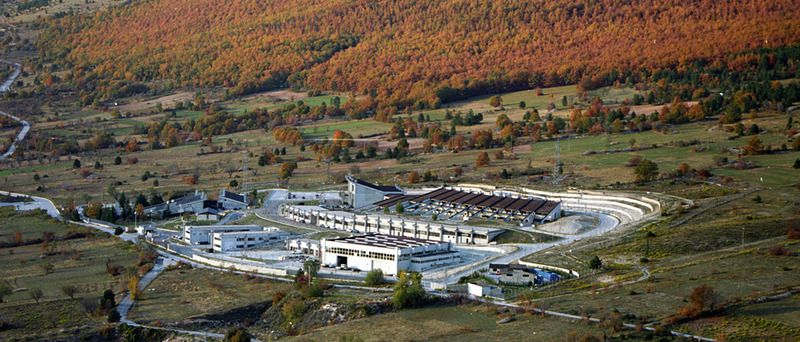
1. Gran Sasso Underground Laboratory (LNGS) – Italy
Located under the Apennines, it is one of the largest underground laboratories in the world. It houses multiple experiments, such as:
• XENONnT This instrument uses liquid xenon to look for WIMP interactions. It is one of the most sensitive on the planet.
• DAMA/LIBRA: Claimed to have detected periodic signals of dark matter, albeit very controversial.
2. SNOLAB – Canada
It is located 2 km deep in a nickel mine and has extremely low radiation conditions. The instruments used for the detection of dark matter are:
• DEAP-3600: Uses liquid argon as the detector material.
• SENSEI: Use silicon detectors to search for light dark matter interactions.
3. Sudbury Underground Laboratory (SNO+) – Canada
Located in the same mine as SNOLAB, but focused on neutrinos and light dark matter.
4. LUX-ZEPLIN (LZ) – USA
This next-generation experiment uses 10 tons of liquid xenon at the Homestake mine in South Dakota. Look for infrequent collisions caused by WIMPs. It is one of the most advanced in the world today.
5. CERN and the Large Hadron Collider (LHC) – Switzerland and France
Although their primary focus is particle physics, the LHC's ATLAS and CMS look for indirect dark matter signals in high-energy collisions.
In addition, FASER and other new LHC experiments are geared toward exotic particles that could be dark matter.
6. China Jinping Underground Laboratory (CJPL) – China
The deepest underground laboratory in the world.
• It houses the PandaX experiment, also based on liquid xenon, with great sensitivity to dark matter particles.
7. DarkSide – Italy
A project that seeks to detect dark matter using liquid argon. He is also staying at the Gran Sasso.
All these laboratories and other scientific tools such as the Fermi Gamma-ray Space Telescope or the AMS-02 (Alpha Magnetic Spectrometer) have helped to provide vital information about the abundance and percentage of dark matter in the universe.
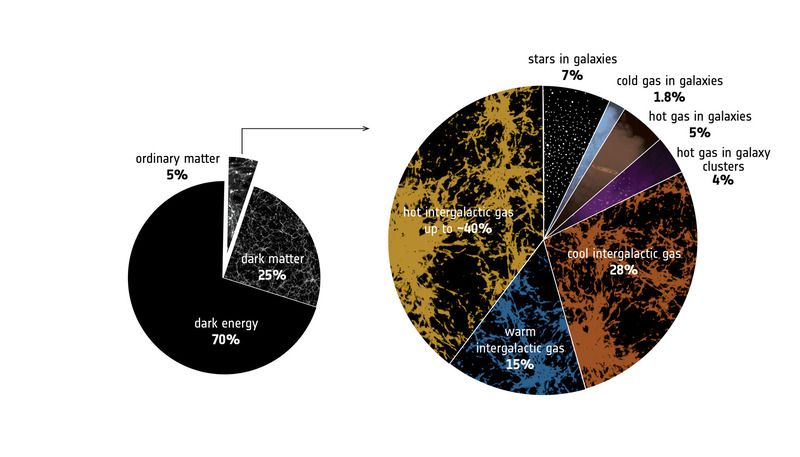
The results agree on something astonishing: dark matter makes up about 25% of the universe's total content, while baryonic matter accounts for just 5%. The rest, an overwhelming 70%, corresponds to the so-called dark energy, another deep mystery that we will discuss in another article.
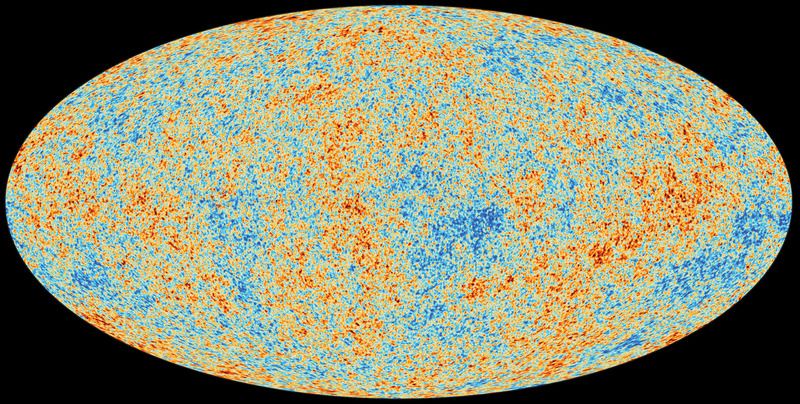
One of the most powerful tools for estimating the amount of dark matter is the cosmic microwave background (CMB). This radiation is a kind of "echo" of the Big Bang, a photograph of the universe when it was just 380,000 years old.
The COBE, WMAP, and Planck satellites have measured the small variations in the CMB's temperature with great precision, which allows us to infer the density of the different components of the early universe.
The pattern of these fluctuations - specifically, the angular scales at which they occur - is directly related to the ratio of dark matter, baryonic matter, and dark energy. In this way, the CMB data have been crucial for quantifying dark matter.
Another powerful method is the study of large-scale structure formation. If the entire universe were composed only of visible matter, galaxies and clusters would not have been able to form as quickly as they did.
Dark matter, not interacting with light or experiencing thermal pressure, began to gravitationally clump together long before baryonic matter, acting as a kind of cosmic "scaffolding" on which visible matter accumulated. Simulations of the universe's evolution with different amounts of dark matter allow us to adjust the models until they match what we observe.
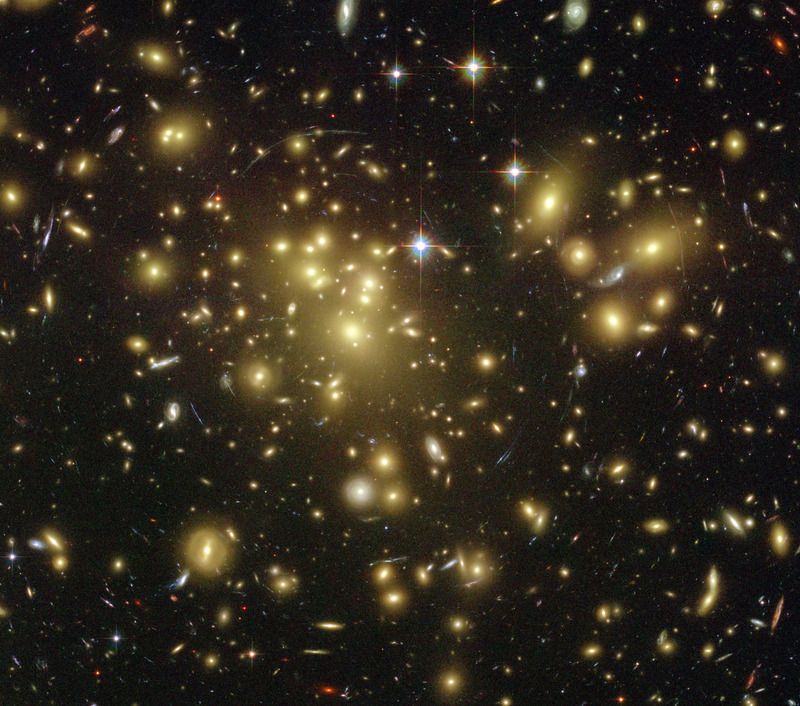
In addition, the effect of gravitational lensing - the deflection of light by the presence of mass - has been key. Observing how light from distant galaxies is warped as it passes through galaxy clusters makes it possible to infer how much mass (visible or not) there is in those clusters.
In most cases, the mass required to explain the deformations is much greater than the visible matter. These gravitational lensing maps have become an effective way to "see" the distribution of dark matter on a large scale.
Finally, the dynamics of individual galaxies, studies of supernovae, and observations of the motion of stars in dwarf galaxies also provide important clues.
All the evidence converges on the same conclusion: there is five times more dark matter than visible matter in the universe. Without it, cosmic structures as we know them would not exist.
Dark matter is one of the great enigmas of the universe. Although we cannot see it, its influence is omnipresent, guiding the formation of galaxies, maintaining their structure, and leaving traces in every corner of the cosmos.
Their existence challenges our understanding of physics, prompting science to look beyond the visible.
I invite readers to reflect on how much we have discovered by observing the invisible and how much more we can learn if we keep curiosity alive.
Dark matter is essential to understanding the universe and reminds us how much there is still to explore.