The life cycle of stars: from nebulae to black holes
They are invisible during the day, but they accompany us every night like small bright spots in the infinite darkness of the universe. We are talking about the stars.
May 7, 2025
They are invisible during the day, but they accompany us every night like small bright spots in the infinite darkness of the universe. We are talking about the stars.
In the past, without all the knowledge and technology that we have today, our ancestors could not know what the stars were. Because they were up there in the sky, unreachable by humans, they attributed them a mystical or religious origin. That's why they usually associated them with gods, hence the names of stars such as Sirius, Altair, or Aldebaran.
But today, thanks to astronomers and their tireless curiosity, we know that stars are like our sun - huge balls of hot plasma. And the reason they look so small from our planet is that they're incredibly far away.
In reality, most stars, like our sun, have planets orbiting them. That is to say that stars are solar systems.
Over time, we have learned that in the universe, nothing is eternal, not even the stars. This means that they were not always there and will not be eternal; on the contrary, just like living beings, stars are born, live, and die.
But how are they formed? Why do some die peacefully and others explode in violent supernovae? Why do some become white dwarfs, others neutron stars, and some black holes?
On this cosmic journey, we will explore stars' life cycles, from their gestation in nebulae to their eternal legacy in the most extreme corners of space-time.
Start!
How stars are born
The birth of a star is a fascinating process in the darkest corners of the universe: nebulae. These immense interstellar gas and dust clouds, composed mainly of hydrogen and helium, are the cradles where stars are gestated.
At first glance, they may seem like static and quiet regions, but they are scenarios of complex gravitational dynamics.
It all starts when a disturbance, such as a shock wave caused by a nearby supernova or a collision between clouds, generates instabilities in the nebula. This causes certain regions within it to collapse under their gravity. As these regions collapse, the material begins to compress and heat, forming what is known as a protostar.
During this stage, the protostar is hidden by a cocoon of gas and dust, visible only through infrared telescopes. The contraction process continues, and the heat generated in the core increases to such an extent that sufficient temperatures and pressures are eventually reached to initiate nuclear fusion. At that critical moment, when hydrogen begins to fuse into helium, the protostar officially becomes a star.
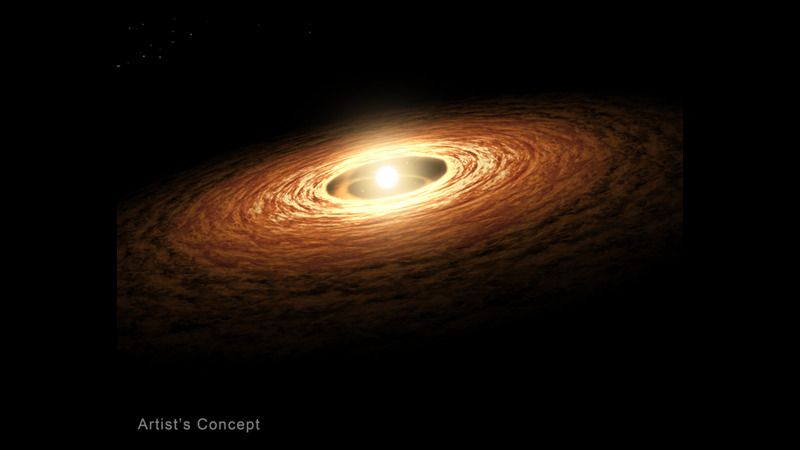
This ignition marks the passage to hydrostatic equilibrium: the gas begins to group together into a sphere. The outward pressure generated by the merger compensates for the force of gravity that tries to collapse the star.
The duration of this formation phase depends on the mass of the gestating star. The most massive stars form in just a few hundred thousand years, while the least massive ones can take tens of millions.
The environment surrounding the young star is also profoundly affected. Stellar wind and ultraviolet radiation scatter the remaining material, exposing the new star, often surrounded by protoplanetary disks that could eventually form planetary systems.
The birth of a star is not just an isolated cosmic event, but an essential part of the galactic evolutionary cycle.
Each generation of stars modifies the interstellar medium, seeding the elements necessary for forming new stars, planets, and life.
Thus, the stars illuminate the universe, chemically enrich and evolve it.
Types of stars, from the most common to the rarest
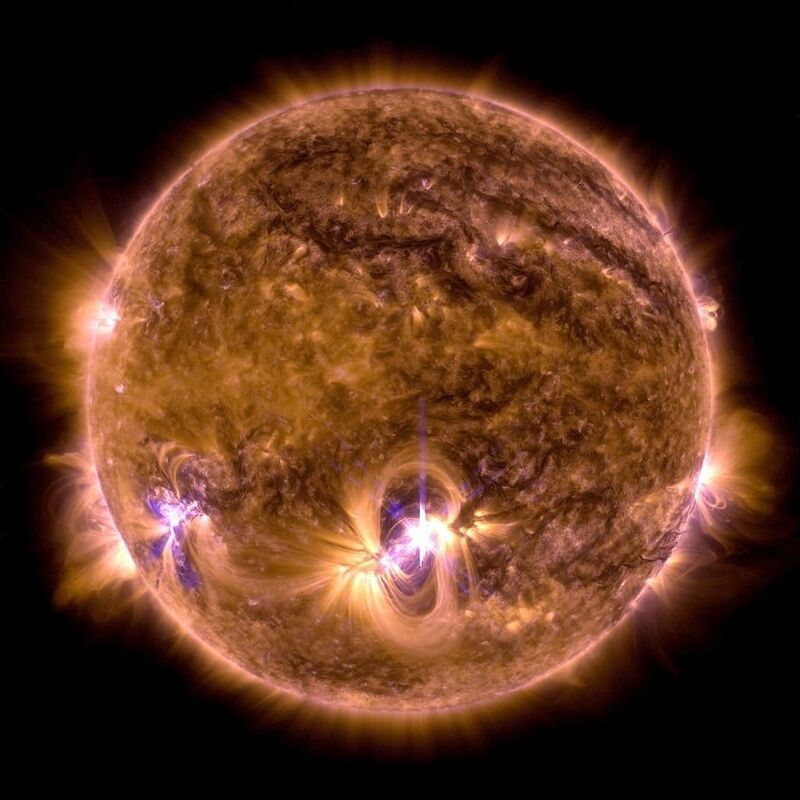
Although stars may appear similar from Earth as simple luminous dots, they present an astonishing variety of types and characteristics. This diversity depends mainly on their mass, surface temperature, composition, and evolutionary stage.
In this vast spectrum, we find everything from humble red dwarfs to colossal blue hypergiants, not to mention peculiar and sometimes enigmatic binary stars.
Red dwarfs are by far the most common type of star in our galaxy. They are small, cold (with surface temperatures below 4,000 K), and not very bright.
Their low nuclear fuel consumption makes them extremely long-lived: they can live billions of years, much longer than the universe's current age. Although they are not visible to the naked eye, they make up the backbone of the Milky Way.
In the middle range, we find stars like our Sun, classified as yellow dwarfs or G-type stars. They have temperatures around 5,500 K and a half-life of about 10 billion years.
These stars are stable enough to allow the formation and evolution of life on nearby planets, as long as conditions allow.
Blue stars, such as type O and B, are higher up the mass and temperature scale. They are extremely hot (exceeding 30,000 K), bright, and massive, but also very ephemeral: they consume their hydrogen in just a few million years.
These stars are responsible for ionizing the gas around them, giving rise to H II regions in nebulae. They usually end their lives in cataclysmic supernovae.
At the extreme end of the rarity scale are hypergiants, some of the largest and most luminous stars ever observed, such as Eta Carinae. They are unstable and violent and often eject some of their mass into space, thus contributing to the chemical evolution of the interstellar medium.
A special chapter in this classification is occupied by binary stars, systems in which two (or more) stars orbit a common center of mass. Binary stars account for a large proportion of known star systems, perhaps even more than 50%.
The study of this type of star is essential, as it allows us to calculate stellar masses with precision, understand mass transfers between companions, and even observe extreme phenomena such as novae and progenitor systems of type Ia supernovae.
Thus, the stellar universe is a true cosmic zoo, full of diversity, complexity, and beauty. Understanding the types of stars allows us to catalog them and anticipate their fate and the role they will play in the evolution of the cosmos.
Star Life: All About the Hertzsprung-Russell Diagram
Understanding the life of a star is like observing the trajectory of a living being: it is born, matures, ages, and finally dies. For astronomers, the Hertzsprung-Russell Diagram (HR) is a fundamental tool for visualizing and classifying this cycle, one of the most significant contributions in the history of astrophysics.
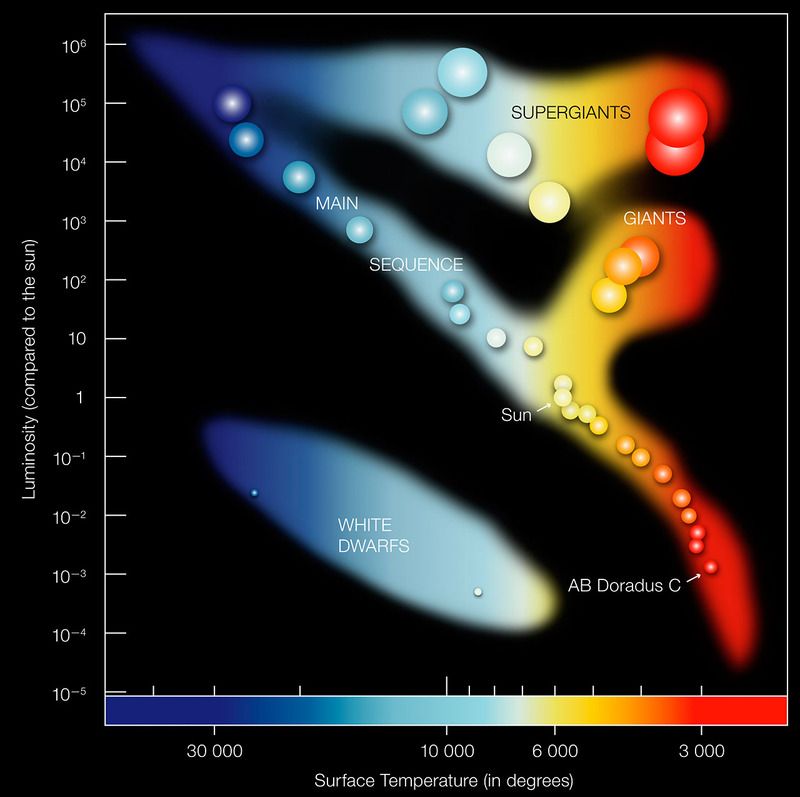
The HR diagram is a graph that represents the luminosity of stars against their surface temperature (or spectral class). Although there are multiple versions, the classic shape of the diagram places the temperature decreasing to the right on the horizontal axis and the luminosity increasing upwards on the vertical axis. By placing thousands of stars on this graph, patterns emerge that reflect clear stages in stellar evolution.
The main sequence, a diagonal band that runs from the upper left corner (blue, hot, and luminous stars) to the lower right (red, calm, and dim dwarfs), is where stars spend most of their lives.
This is where the stable fusion of hydrogen into helium occurs, as in the case of the Sun. The specific position of a star within this band depends mainly on its mass: the most massive are at the top, while the least massive are located below.
When a star exhausts the hydrogen in its core, it leaves the main sequence and enters a new phase.
Stars like the Sun expand and become red giants, moving toward the top right of the diagram. There, its surface temperature decreases, but its volume and luminosity increase.
In the case of more massive stars, after exhausting hydrogen, they can undergo multiple phases of fusion, burning progressively heavier elements such as helium, carbon, and oxygen. These processes cause stars to travel complex trajectories within the HR diagram, often entering the region of supergiants.
Finally, many stars end their lives outside the main sequence, in areas such as the white dwarfs in the lower left of the diagram. These stars are small and hot but not very luminous, as they no longer generate energy and simply radiate the residual heat from their collapse.
The HR diagram is not only an evolutionary map, but also a compass that allows us to understand the history and fate of any star.
Thanks to this representation, it is possible to estimate stellar ages, predict behaviors and even deduce the history of complete populations of stars in clusters or galaxies.
Death of the stars: the decline of hydrogen and the different stellar endings
Just as stars are born in nebulae and live on the main sequence of the HR diagram, all, without exception, are destined to die. How a star ends its life depends mainly on one factor: its initial mass. As they deplete their fuel, mainly hydrogen, they face a duel between thermal pressure and gravity; the one that wins the duel will determine the star's ultimate fate.
A star fuses hydrogen into helium in its core for most of its life. This fusion releases an immense amount of energy that generates an outward thermal pressure, counteracting the force of gravity that crushes it towards its center.
When hydrogen is depleted in the core, that pressure source disappears. Then, gravity begins to win the battle.
In low-mass stars (up to about 8 times the mass of the Sun), the initial collapse of the core causes the outer layers to expand dramatically, turning the star into a red giant.
During this stage, helium fuses into carbon and oxygen in the core. But these stars don't have enough mass to reach the temperatures needed to fuse heavier elements.
Finally, the outer layers are ejected into a planetary nebula, leaving behind a dense and hot core: a white dwarf.
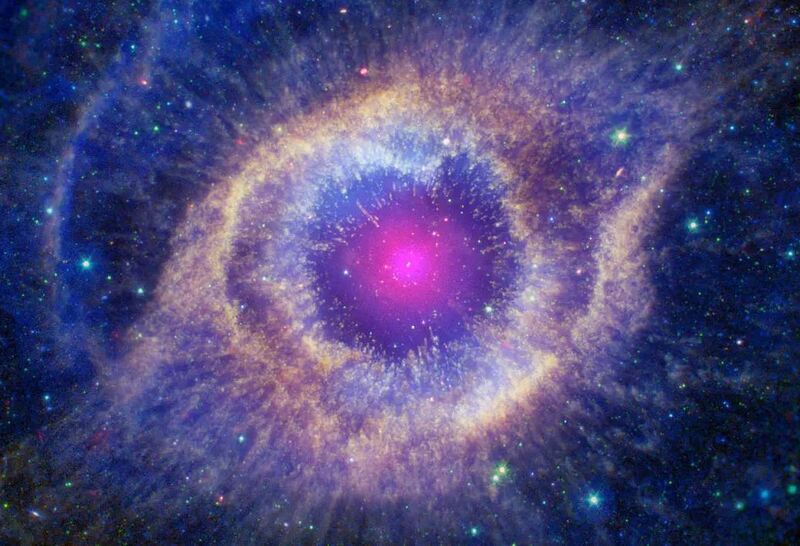
In contrast, the process is more complex and violent in high-mass stars. After the supergiant stage, these stars begin a chain of mergers of heavier elements, such as carbon, oxygen, neon, magnesium, silicon, and, finally, iron.
Iron represents a dead end: it cannot fuse to release energy, but absorbs energy when it tries. This triggers a catastrophic gravitational collapse of the core.
This collapse causes one of the most powerful explosions in the universe: a supernova. During this event, the star shines with the intensity of an entire galaxy for a few days or weeks.
The supernova scatters the heavy elements created in the core into space, enriching the interstellar medium, and can also trigger the formation of new stars in nearby regions.
What remains after the supernova again depends on the mass of the collapsed core. A neutron star will form if it has between 1.4 and 3 times the solar mass. If it exceeds that threshold, gravity is unstoppable, and the core collapses into a black hole, an object of infinite density and extreme gravity.
The death of a star, far from being the end of its history, marks the beginning of new cosmic transformations. In many ways, it is a stage that redefines the universe: in their last breaths, the stars return to the cosmos the elements forged within them, laying the foundations for new suns, planets... and perhaps life.
Life After Death: White Dwarfs, Neutron Stars, and Black Holes
The death of a star does not necessarily imply its disappearance. On the contrary, the remnant it leaves behind can endure for billions of years, taking on exotic new forms that challenge our understanding of physics.
These shapes constitute what we might call the "second life" of stars, and vary drastically according to the mass of the parent star.
White dwarfs are the ultimate destination of most stars in the universe, including Sun-like ones. They are collapsed, dense stellar nuclei that no longer produce energy through nuclear fusion. Its size is comparable to Earth's, but its mass is similar to the Sun's.
A teaspoon of matter from a white dwarf can weigh several tons. These degenerate stars emit waste heat and cool slowly over billions of years.
Theoretically, they will eventually become black dwarfs, cold, invisible bodies, although the universe is not yet old enough for any to have formed.
When the progenitor star has more mass, the post-supernova gravitational collapse can give rise to a neutron star.
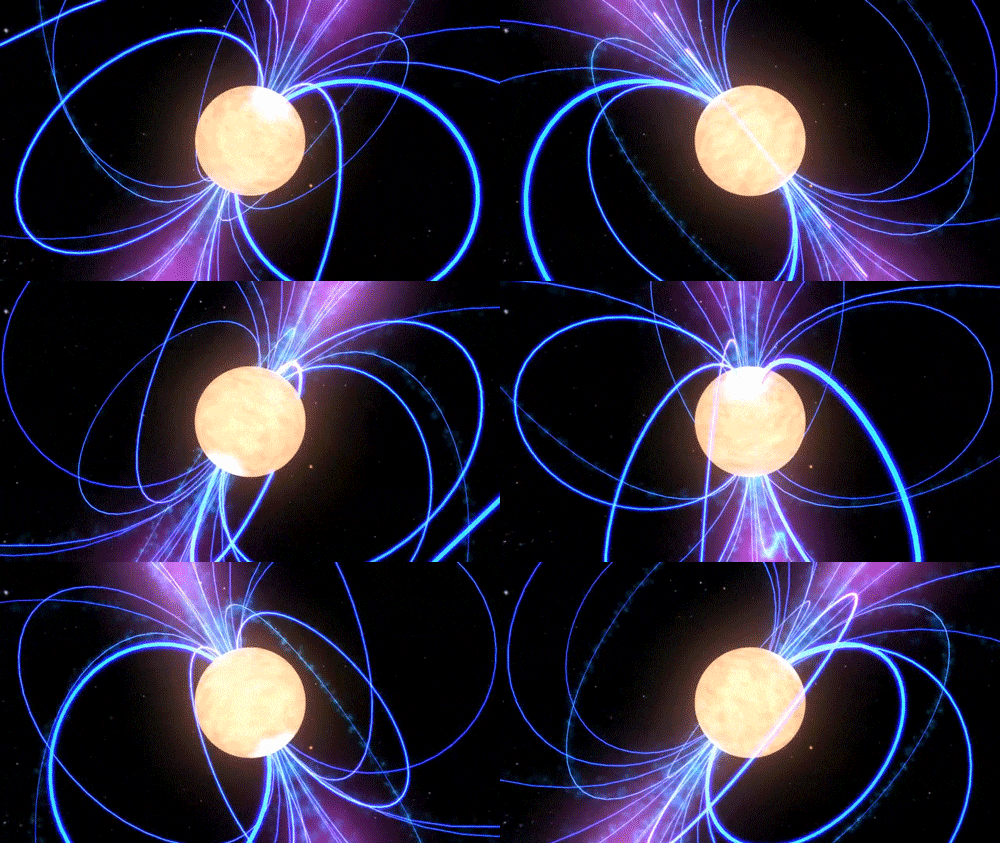
Although these objects have a diameter of only about 20 kilometers, they contain more mass than the Sun. They are composed almost exclusively of neutrons, resulting from the extreme compression of atomic nuclei.
They are incredibly dense: one teaspoon of their matter would weigh tons. Some neutron stars rotate rapidly and emit radiation beams: they are pulsars, authentic cosmic beacons detectable from Earth with radio telescopes.
Finally, if the collapsed core exceeds the threshold of about three solar masses, not even the degeneracy pressure of the neutrons can sustain it. The result is a black hole, a region of space-time with such intense gravity that not even light can escape.
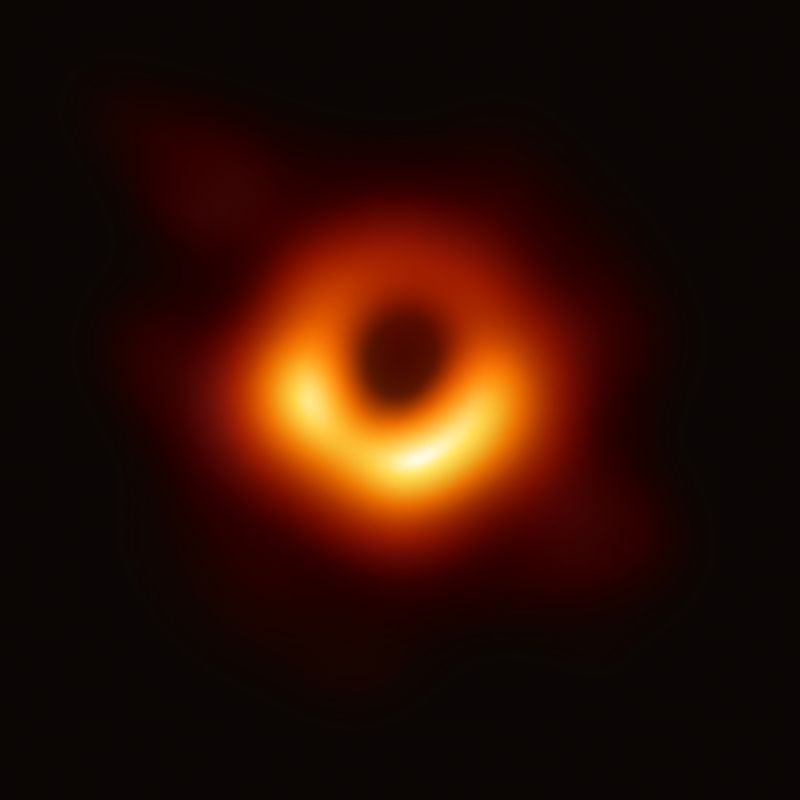
Black holes are not "cosmic vacuum cleaners," as they are sometimes popularly depicted; their effect depends on distance. However, their formation represents a radical transformation of the fabric of the universe, and their study has opened a new era in astrophysics thanks to the detection of gravitational waves and images of the event horizon.
Each of these fates—white dwarf, neutron star, or black hole—is not simply a stellar corpse, but an active entity that profoundly influences its environment.
Whether radiating energy, emitting pulses, bending space-time, or devouring nearby matter, these final forms are silent witnesses to the stellar past and engines of the cosmic future.
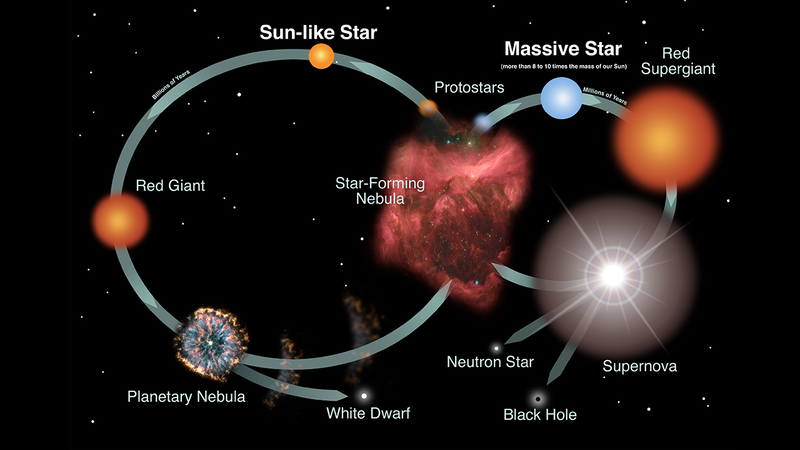
The life cycle of stars is a fundamental pillar of astronomy and a window into the origin of everything we know.
We are, literally, the result of ancient stellar explosions; Every atom of oxygen, carbon, or iron in our bodies was forged in the heart of a star. Understanding this cycle connects us to the universe in an intimate and transcendental way.
I invite the reader to contemplate the sky with a new gaze, knowing that each point of light holds a story of birth, transformation, and cosmic legacy that has shaped our world.