Exploring the Multiverse: Is our universe one of many
Imagine that everything you know - the sky, the earth, yourself - is but one possibility among infinite possibilities. Universes where the laws of physics are different, where you were born in another era... or you never existed.
April 7, 2025
Imagine that everything you know - the sky, the earth, yourself - is but one possibility among infinite possibilities. Universes where the laws of physics are different, where you were born in another era... or you never existed.
If you imagined any of those scenarios, congratulations, that's how the theory of multiverses works. This fantastic theory is very popular today thanks to Hollywood movies that invite us to think of infinite scenarios with infinite possibilities.
But what does science say about this theory? Could there be other universes besides our own? And if so, what would they be like?
In this article, we will accompany you in discovering it. Let's get started!
Is it one or several theories?
The theory of multiverses is one of the most fascinating and perplexing ideas in modern physics. It proposes that our universe - with its galaxies, stars, planets, and physical laws - could be just one of many, perhaps even infinite, that make up a larger structure known as the "multiverse."
This hypothesis is not limited to imagination, but arises from serious and mathematically consistent extensions of current physical theories such as quantum mechanics, inflationary cosmology, and string theory.
There are several versions of the multiverse, commonly classified into four levels, proposed by the Swedish physicist Max Tegmark:
Level I
Universes that exist beyond the observable cosmological horizon. They are regions of the same space-time, but so far away that the light from those places has not had time to reach us since the Big Bang.
These universes would have the same physical laws as ours, but different configurations of matter and life forms.
An example of cinema of Level 1 could be the one presented in the 2014 film Interstellar, where the protagonists never leave the universe. Still, the region they travel to is so far away that a wormhole is the only way to get there.
Level II
Derived from inflationary theory, these multiverses arise from bubbles of inflationary space-time that stop expanding in different regions, forming universes with different physical constants or fundamental laws.
An example of cinema at this level is the Marvel film Doctor Strange in the Multiverse of Madness (2022). In this film, we are shown universes completely different from our own, with altered physical rules, landscapes, and characters.
Level III
Based on the "many worlds" interpretation of quantum mechanics, in which every event or every decision gives rise to a "branching" of the universe. Each possible outcome occurs in a parallel universe that coexists with the others.
In the world of fiction, we have, for example, the anime Dragon Ball Z, where every time the character "Trunks" traveled to the past, he created a new timeline, similar to creating new universes that coexist simultaneously.
Level IV: This level proposes that all mathematically possible universes exist. It is the most abstract and controversial level, which postulates that reality is essentially a mathematical structure.
In science fiction, the best example at this level is the TV comedy series "Rick and Morty", in which the protagonists have a portal gun that allows them to travel to any imaginable universe, each with slight differences.
From a universe where humans are teddy bears, another where we evolved from shrimp, another where we evolved from wasps, etc.
Although it is a comedy, it is the simplest way to exemplify how this multiverse would work.
Each level offers a different view of reality but shares a common idea: our universe would not be unique.
These proposals, far from mere fantasies, emerge as plausible solutions to the equations and problems that physicists face today. The big question is: if these other universes exist, how might we detect or interact with them?
From the Big Bang to the Many Worlds
The idea that there could be worlds besides our own is not unique to modern science. However, our ancestors lacked telescopes, particle accelerators, and complex mathematical models. As early as 2000 years ago, the Anaximander of Miletus (610–546 BC) proposed that our world was not unique, but one among many.
Later, Democritus of Abdera (c. 460–370 BCE) claimed that atoms in eternal motion generated an infinite number of worlds, each with its laws. This thought was taken up and developed by Epicurus (341–270 BC), who wrote:
"There is not a single world, nor a limited number of worlds; worlds are infinite."
For these thinkers, the known universe was only the Earth and everything in the celestial vault, so they surely did not imagine universes but rather planets. But the idea is the same.
Just as they imagined that there could be other worlds like Earth, today we imagine that there could be other universes like ours.
The concept of multiple universes resurfaced strongly in the twentieth century, not as a philosophical intuition, but as a mathematical and logical necessity derived from increasingly precise physical theories.
As quantum physics and inflationary cosmology evolved, inevitable questions arose: Why does our universe have the physical constants it does?
Why does it seem "adjusted" to allow life?
And what about the other unrealized possibilities?
The answers led scientists to think in terms of multiple realities.
Hugh Everett III was one of the first to propose a scientific theory of multiple universes in 1957. His famous interpretation of the many worlds of quantum mechanics challenged the notion of wave function collapse.
According to Everett, the universe splits in every quantum event with multiple possible outcomes, giving rise to a reality for every possible outcome. For example, if you flip a coin, there is a universe where heads land and another where tails land.
These bifurcations occur constantly and give rise to an immense network of parallel worlds that coexist but do not interact.
Although initially ignored, Everett's theory gained popularity over time and is today considered a viable interpretation by many physicists.
At the end of the 20th century, the Russian physicist Andrei Linde developed the theory of eternal chaotic inflationism, based on the accelerated expansion of the Big Bang.
This theory suggests that space-time could continuously inflate in different regions, generating "bubbles" or independent universes with different physical properties. Our universe would then be just one of those bubbles.
In collaboration with James Hartle, Stephen Hawking proposed the "no-edge" model of time, in which the universe would not have a definite beginning but gently emerged from a quantum state. In this framework, one can think of a "wave function of the universe" that encompasses multiple possible histories of the cosmos, each with its reality.
Although more abstract than other proposals, this idea suggests that multiverses could be the natural result of applying quantum mechanics to the entire universe.
Finally, Max Tegmark took the concept to a more extreme level by classifying multiverses into the four levels mentioned above and proposing that all mathematically possible structures exist as physical realities. For Tegmark, if a mathematical structure is consistent, it exists at some level of reality.
In search of other universes
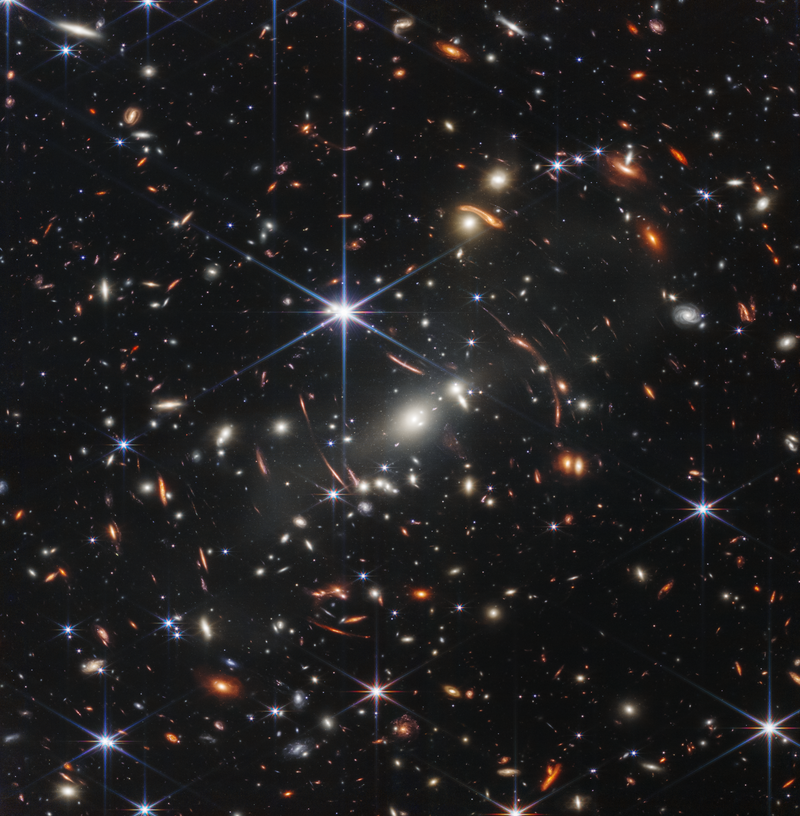
So far, we have seen different theories about the multiverse, but what does the evidence say?
Searching for evidence of the multiverse is one of the most significant challenges of modern physics. Unlike other scientific hypotheses, multiverses would, by definition, be outside our observable universe, complicating any direct attempt at detection.
However, physicists have not stopped at this conceptual barrier. Through bold ideas and theoretical models, they look for indirect traces that could betray the existence of realities beyond our own.
One of the most interesting proposals comes from studying the cosmic microwave background (CMB), the radiation left over from the Big Bang that fills the entire universe.
In 2010, a team led by physicist Anthony Aguirre and cosmologist Matthew Johnson proposed that, if two bubble universes collide, they would leave a kind of circular "mark" on the CMB. Although some circular patterns have been detected, they have not been conclusive enough to confirm this hypothesis.
Another avenue of research is quantum vacuum fluctuations. In the framework of string theory, our universe could be a "brane" (a kind of higher-dimensional membrane) floating in a larger multidimensional space, the bulk.
Other parallel branes/universes could exist in this space. Collisions or interactions between these branes could leave observable signals, for example, gravitational waves. The LIGO experiment, which first detected gravitational waves in 2015, opened a new window to explore extreme cosmic phenomena that, in theory, could be related to inter universal events.
As for the possibility of traveling or communicating with other universes, theories vary.
In the inflationary multiverse, the universes are so far apart that interaction would be virtually impossible due to expansion speeds exceeding that of light.
In the many quantum worlds, the separation is not spatial, but of branches of reality, so interaction is also ruled out.
However, some speculative models have proposed the existence of wormholes that could connect distant regions - or even distinct universes - although there is no empirical evidence that they exist or are stable.
While divergent in their details, these theories point to a common conclusion: if the physics we know is correct, other universes are not only possible but perhaps inevitable.
Do we have proof of their existence?
Talking about evidence in science requires rigor, repeatability, and direct or indirect observation. In the case of the theory of multiverses, we are still far from having conclusive proof. However, some findings and anomalies have generated plausible hypotheses that keep alive the possibility that other universes exist.
One of the most debated clues comes from the Great Void of Eridanus. This gigantic region of the sky, discovered thanks to maps of the cosmic microwave background such as those of the Wilkinson Microwave Anisotropy Probe (WMAP) mission, contains up to 10,000 fewer galaxies than expected.
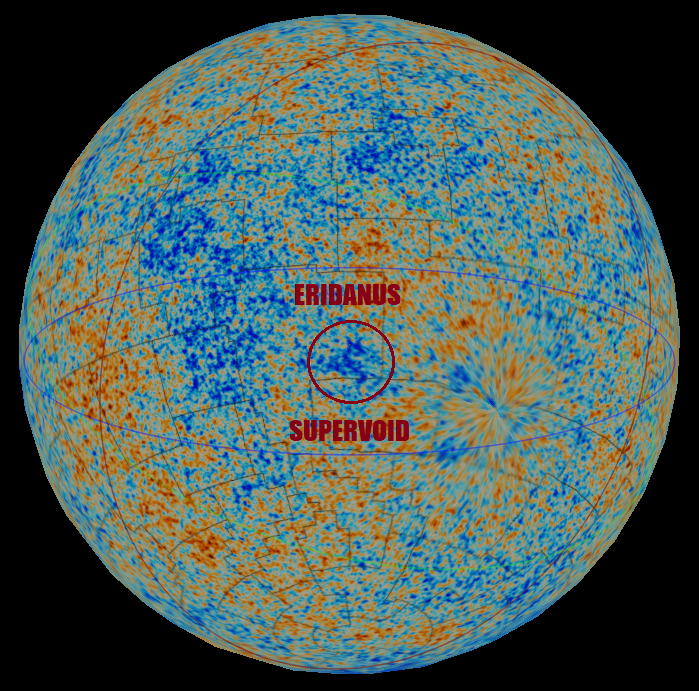
Its temperature is also abnormally low. Some researchers, such as Laura Mersini-Houghton, have suggested that this "cold zone" could be a gravitational mark left by a parallel universe that collided or interacted with ours in the past.
However, other astrophysicists propose less exotic explanations, such as statistical fluctuations within the ΛCDM (Lambda-Cold Dark Matter) model.
Another line of indirect evidence comes from the tight configuration of the universe's physical constants.
If the strong nuclear force, electron charge, or cosmological constant were slightly different, there would be no stable atoms, stars, galaxies, or life.
This "fine-tuning" has been used as an argument for the inflationary multiverse: in an almost infinite number of universes with different constants, some- like ours - would have the right conditions by simple probability.
In particle physics, string theory predicts a "landscape" of more than 10^500 possible solutions, each describing a different universe with distinct laws and constants.
Although we cannot currently access these solutions or empirically verify which corresponds to our own, the fact that mathematics allows it suggests that other universes are at least a robust theoretical possibility.
In experimental terms, futuristic proposals have been designed, such as studying primordial gravitational waves or quantum correlations that could reveal physics beyond the Standard Model. Still, none so far has shown unequivocal signs of other universes.
It has also been proposed that the Hawking radiation of black holes be studied to detect traces of other universes if the information escapes from them through quantum tunnels to other realities.
Despite the lack of hard evidence, the multiverse theory has sparked a philosophical and cosmological revolution.
If there are other universes with different laws, our reality is not universal, but a local manifestation of something much more vast. We would no longer be the center of the cosmos, not even a fortunate exception, but one more possibility among various variants.
This paradigm shift invites us to rethink everything: Why does the universe exist?
Are living beings a product of chance, or do they have a purpose?
How does human consciousness fit into a cosmos so vast that it could include alternative versions of ourselves, or realities where the laws of physics make life impossible?
Accepting the possibility of multiverses does not weaken science; it enriches it. It forces us to look beyond our observable limits, refine our theories, and imagine new ways of experiencing and understanding reality.
We may never get to visit other universes, but the search itself pushes us to explore more deeply the only universe we can study directly: our own.
At its core, every step toward understanding the multiverse is also a step toward knowing ourselves.
And while the multiverse is still conjecture, its potential existence reminds us of a fundamental truth of science: the universe is always bigger, stranger, and more fascinating than we imagine.