Eagle Nebula: Everything you need to know about this fascinating constellation

The Eagle Nebula, also known as Messier 16 or M16, is an impressive star-forming region located approximately 7,000 light-years from Earth in the Serpens constellation. This nebula is famous for its Pillars of Creation, vast columns of gas and dust where new stars are born. M16 combines an open cluster of bright young stars with a vast molecular cloud illuminated by the ultraviolet radiation of these stars.
April 1, 2025
Its name comes from its characteristic shape, which, seen from ground-based telescopes, resembles an eagle in flight, spreading its wings over a sea of interstellar gas.
Because it is so famous, photographing her is the goal of most amateur astronomers.
Prepare! This article will explain everything you need to know about this fascinating constellation, from its origin to how to photograph it successfully.
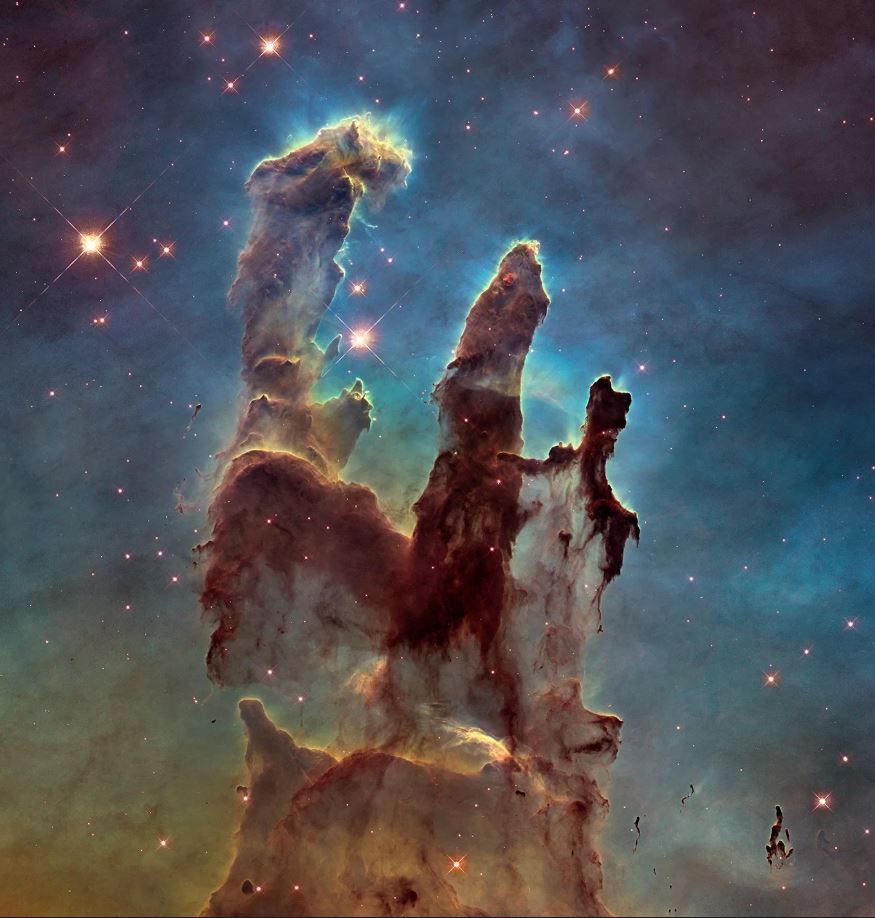
Eagle Nebula: Main features
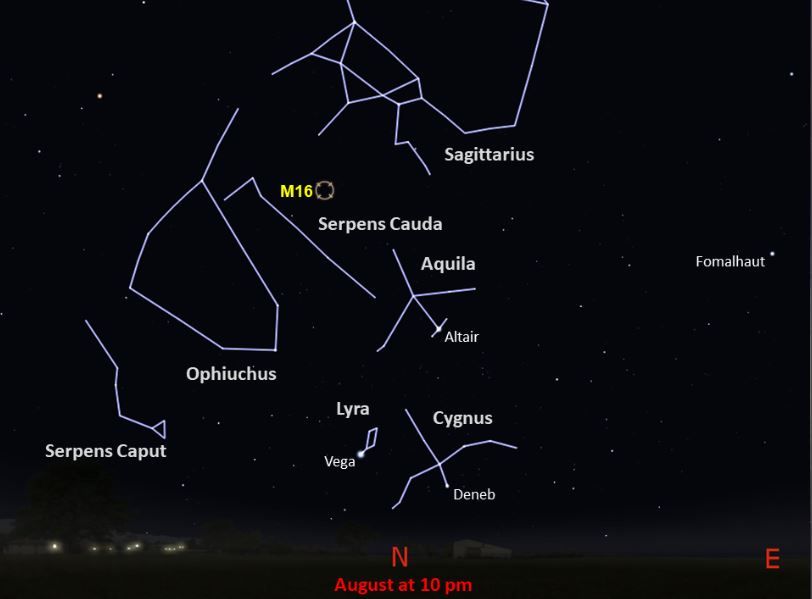
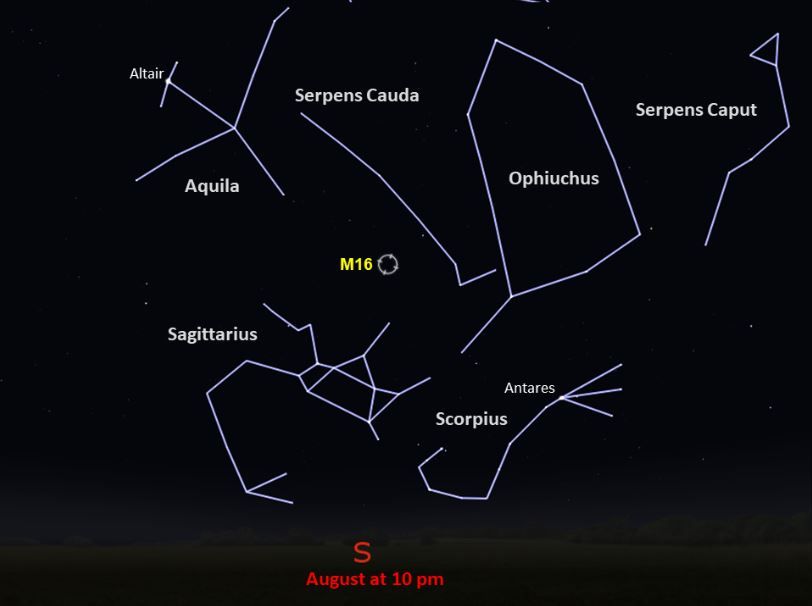
The Eagle Nebula, formally known as Messier 16 (M16), is a vast region of gas and dust located approximately 7,000 light-years from Earth, in the direction of the Serpens constellation, specifically in the subdivision known as Serpens Cauda, or the Serpent's Tail.
It is an active star-forming region, which means that new stars are constantly being born and evolving inside it from the gravitational collapse of dense clouds of molecular gas.
The nebula measures around 70 x 55 light-years, although the most photogenic area, where the famous Pillars of Creation are located, is much smaller, about five light-years across.
The name "Eagle Nebula" comes from visual observers of the 19th and 20th centuries who noticed that the dark outline of dust seemed to resemble an eagle spreading its wings over a sea of glowing gas.
Importantly, the star that originated this nebula is not a single star but a complete cluster of massive stars. These stars have shaped the region over millions of years, creating this spectacular cosmic landscape we admire today with telescopes and space cameras.
Visually, the Eagle Nebula combines a bright open cluster of hot, young stars known as NGC 6611, embedded within a vast cloud of glowing gas and dark dust.
This star cluster illuminates the nebula with its intense ultraviolet radiation, which ionizes the surrounding gas, causing it to glow mainly in the hydrogen emission band (H-alpha). The contrast between the glowing gas and the dark dust creates M16's signature visual structures.
The shape that gives it its name — the outline of an eagle with outstretched wings — results from the erosion and sculpting of dust clouds by radiation and stellar winds emitted by the newly formed massive stars in the cluster.
This process, known as photoevaporation, sculpts the plumes of dense gas and dust that survive the harsh environment.
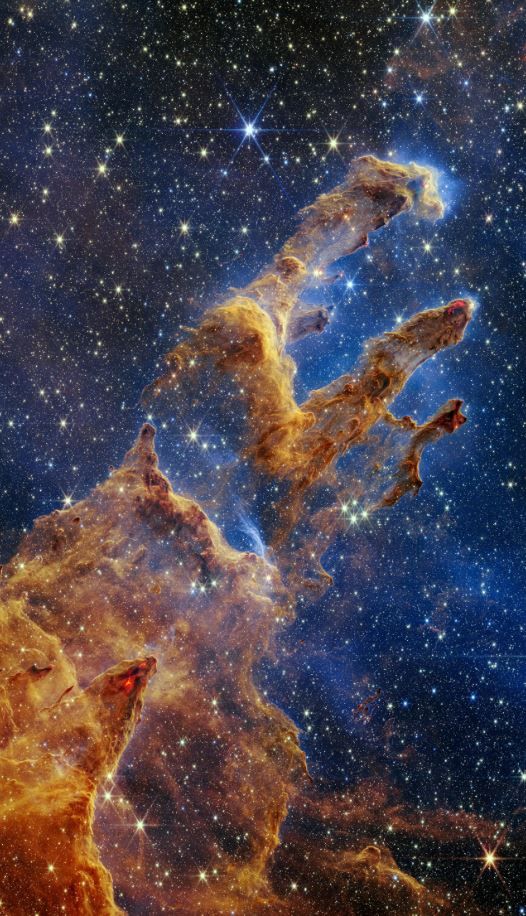
The Pillars of Creation
The Pillars of Creation are arguably the most iconic structures in the Eagle Nebula and one of the most recognizable images in the history of astronomy. These colossal plumes of cold gas and dark dust emerge from the nebula's heart, and their origin is directly linked to the intense star-forming activity occurring in the region.
They formed about 1 to 2 million years ago, when radiation and winds from young, massive stars sculpted the surrounding gas and dust, leaving only dense filaments of matter that resisted erosion.
At their ends, the Pillars harbor evaporating gaseous globules (EGGs), tiny nests of dense material that contain protostars in formation.
The Pillars are about 4 to 5 light-years tall, which means that between 60 and 70 solar systems could comfortably fit inside them aligned from end to end.
However, these cosmic monuments will not be eternal. It is estimated that, due to constant erosion by ultraviolet radiation, the Pillars will disappear entirely in about 100,000 years, an extremely short period in astronomical terms. Their study offers us a direct window into the process of star birth in the cosmos.
First observations of the Eagle Nebula
Although nebulae such as the Eagle were not identified as such by ancient civilizations, it is very likely that cultures that observed and recorded the sky noticed the presence of a blurred and enigmatic region in the constellation of Serpens.
Civilizations such as the Babylonians, Chinese, and Mayans, with their meticulous astronomical observation, left detailed celestial maps. However, they lacked instruments that would allow them to distinguish between open clusters, diffuse nebulae, or concentrations of stars.
Therefore, although this region of the sky may have been observed, it was not documented as a nebula proper.
The first modern record of what we know today as Messier 16 occurred in 1745, when Swiss astronomer Jean-Philippe Loys de Chéseaux included it in his catalog of star clusters.
However, it is essential to clarify that de Chéseaux did not describe the nebula, but only the open cluster of young stars (NGC 6611), which is an integral part of the structure of M16. This is because telescopes of the time lacked sufficient sensitivity to detect the surrounding faint clouds of gas and dust.
Just 19 years later, in 1764, the French astronomer Charles Messier, famous for his catalog of deep-sky objects, rediscovered the cluster and designated it Messier 16 (M16).
Messier described it as an open cluster visible with modest instruments like its predecessor. In his notes, he mentioned that the cluster appeared immersed in a slight haze but could not identify the nebula as an independent structure. This situation was common in astronomy in the eighteenth century, when the ability to detect diffuse gas was limited.
It wasn't until the 19th century that more advanced telescopes, such as William Herschel's reflector, began to reveal the presence of nebulous structures associated with M16.
Still, the term "Eagle Nebula" didn't appear until the 20th century, when early astrophotographers were able to capture long-exposure images that clearly showed the dark silhouette of dust, which resembled an eagle spreading its wings. This distinctive shape ultimately inspired the modern name.
Today, we know that early astronomers only observed a small fraction of the complexity of M16, an object far more majestic and dynamic than eighteenth-century optics could reveal.
What we know today about the Eagle Nebula
Today, the Eagle Nebula (M16) is recognized not only as one of the most beautiful and photogenic star-forming regions in the Milky Way but also as a fundamental cosmic laboratory for the study of star birth and evolution.
Thanks to advances in astronomical technology and astrophotography, the image we have today of the Eagle Nebula is infinitely more detailed and revealing than the one that early astronomers were able to observe.
What in the eighteenth century was just a star cluster faintly shrouded in a faint haze today reveals itself as a complex network of ionized gas, dark dust, and structures sculpted by stellar forces, with a visual and scientific richness that continues to amaze.
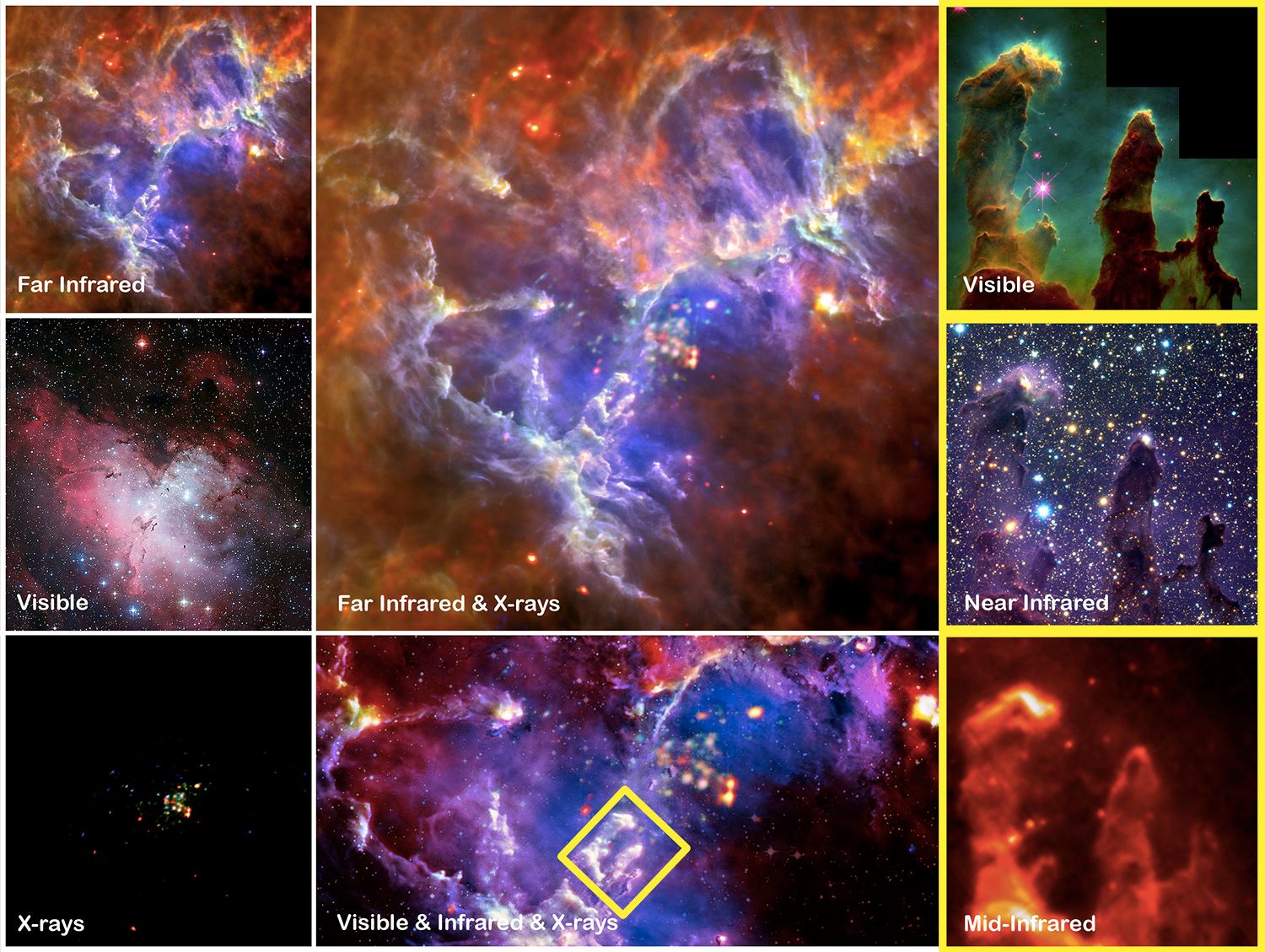
The modern vision of M16 has been enriched by observation at multiple wavelengths. In visible light, captured by ground-based and space-based optical telescopes, the nebula shows reddish and green hues, reflecting the emission of ionized hydrogen (Hα), oxygen (OIII), and sulfur (SII).
However, when observed in the infrared, as the James Webb telescope has done, the dust that obscures entire regions becomes transparent, allowing us to see stars in formation shrouded in cocoons of gas and dust. This multispectral view has radically transformed our understanding of the nebula's internal and dynamic structure.
The difference is abysmal compared to what astronomers could see 200 or 300 years ago.
To them, the Eagle Nebula was little more than a cluster of stars with some diffuse glow. Today, we know that this glow is the glow of excited hydrogen gas and that the nebula's complexity includes ionization fronts, plumes of cold gas, cavities carved by ultraviolet radiation, and jets of matter launched by newborn protostars.
How to Observe the Pillars of Creation
Capturing the dark structure of the Pillars and its contrast with the glowing gas is a technical challenge but one of the most satisfying achievements for any deep-sky astrophotography.
However, our readers should know that the pillars are not visible with small telescopes for beginners as they are very faint and low-contrast structures submerged within the Eagle Nebula (M16).
Although M16 is observable from dark skies with modest telescopes ( 100 mm or 4 inches aperture), only you will see the star cluster NGC 6611 and a diffuse hazy glow.
With no special filters and small openings, the Pillars are virtually invisible.
What telescopes can you use to see them?
To observe indirectly (i.e., notice their presence as dark structures within the nebula), at least a telescope with a 10- to 12-inch (250-300 mm) aperture, from a very dark sky and with excellent atmospheric transparency, is recommended.
But consider that even under those conditions, the Pillars barely hint at themselves as areas of darkness silhouetted against the nebula's bright background. What the eye sees is much less detailed than what a camera can capture.
Pillars of Creation in astrophotography
The story changes if you want to capture them using astrophotography instead of seeing them directly with your eyes.
It's ideal for a telescope with an aperture between 80mm and 130mm and a focal ratio of f/5 to f/7.
If you accompany this with a sensitive astronomical camera and narrowband filters (especially H-alpha), you can clearly record the Pillars of Creation at long exposures (several cumulative hours).
Short-focal telescopes allow the entire nebula complex, including the Pillars of Creation and the surrounding gas clouds, to be captured.
Cooled astronomical cameras, preferably monochrome, are the best option, although DSLR cameras modified to capture H-alpha are also suitable.
Remember that although the human eye cannot see them directly, a camera can detect them with tiny instruments.
In short, you need a considerable telescope to see them well with your own eyes. Still, with astrophotography, proper cameras, and filters, you can capture them even with modest-sized instruments.
The Eagle Nebula is not just another astronomical object; it is a direct window into the process of star creation, one of the fundamental functions that shape the evolution of our galaxy.
Observing it, whether with a modest telescope or through astrophotography, is much more than admiring a distant gas cloud.
It is witnessing the birth of future stars and planets, perhaps worlds with potential for life, floating in the delicate balance of gravity and radiation. M16 is a rewarding challenge for amateur astronomers, inviting them to perfect observation and processing techniques.
For astrophotographers, it represents an ever-evolving masterpiece, a lens that mixes art and science.
Each image is unique, each attempt reveals new details, and, above all, each look connects us with the immensity and complexity of the cosmos, reminding us of our humble place in it.